Algorithms written in high-level languages (e.g. C) will look very obvious when you are looking at the source code. However, the compiler can convert them into rather mysterious patterns at assembly level. To improve our reverse-engineering skills, we need to learn about those patterns so that we can identify them quickly. This blog post will list some examples, based on what I encountered while solving a CTF challenge today.
Signed Divisions Between Integers
Take this code for example:
#include <stdio.h>

int div(int a)
{
    return a / 42;
}

int main()
{
    int a;
    scanf("%d", &a);
    a = div(a);
    printf("%d", a);
    return 0;
}
Compile it, fire up your shiny iaito or radare2, and look at the assembly. We do not need to care about main(), so we can go straight to sym.div, where we can see something like this:
36: div (int64_t arg1);
`- args(rdi) vars(1:sp[0xc..0xc])
0x00001149      push     rbp
0x0000114a      mov      rbp,    rsp
0x0000114d      mov      dword [var_4h],  edi ; arg1
0x00001150      mov      eax,    dword [var_4h]
0x00001153      movsxd   rdx,    eax
0x00001156      imul     rdx,    rdx,    0x30c30c31
0x0000115d      shr      rdx,    0x20
0x00001161      sar      edx,    3
0x00001164      sar      eax,    0x1f
0x00001167      sub      edx,    eax
0x00001169      mov      eax,    edx
0x0000116b      pop      rbp
0x0000116c      ret
We do not see an idiv instruction here. Instead, we can see an imul instruction at 0x00001156, followed by a shr instruction and a sar instruction. After that, the result is in the edx register.
But what happens if we use a different number? Let us try that. Compile this:
#include <stdio.h>

int div(int a)
{
    return a / 6;
}

int main()
{
    int a;
    scanf("%d", &a);
    a = div(a);
    printf("%d", a);
    return 0;
}
And we will get a similar disassembly:
33: div (int64_t arg1);
`- args(rdi) vars(1:sp[0xc..0xc])
0x00001149      push     rbp
0x0000114a      mov      rbp,    rsp
0x0000114d      mov      dword [var_4h],  edi ; arg1
0x00001150      mov      eax,    dword [var_4h]
0x00001153      movsxd   rdx,    eax
0x00001156      imul     rdx,    rdx,    0x2aaaaaab
0x0000115d      shr      rdx,    0x20
0x00001161      sar      eax,    0x1f
0x00001164      sub      edx,    eax
0x00001166      mov      eax,    edx
0x00001168      pop      rbp
0x00001169      ret
What happens if we use a negative number? Replace 6 with -7, and we will get something similar:
36: div (int64_t arg1);
`- args(rdi) vars(1:sp[0xc..0xc])
0x00001149      push     rbp
0x0000114a      mov      rbp,    rsp
0x0000114d      mov      dword [var_4h],  edi ; arg1
0x00001150      mov      eax,    dword [var_4h]
0x00001153      movsxd   rdx,    eax
0x00001156      imul     rdx,    rdx,    0xffffffff92492493
0x0000115d      shr      rdx,    0x20
0x00001161      add      edx,    eax
0x00001163      sar      edx,    2
0x00001166      sar      eax,    0x1f
0x00001169      sub      eax,    edx
0x0000116b      pop      rbp
0x0000116c      ret
What happens if we do not use a constant? Compile this:
#include <stdio.h>

int div(int a, int b)
{
    return a / b;
}

int main()
{
    int a, b;
    scanf("%d %d", &a, &b);
    a = div(a, b);
    printf("%d", a);
    return 0;
}
After that, we finally get something different:
19: div (int64_t arg1, signed int64_t arg2);
`- args(rdi, rsi) vars(2:sp[0xc..0x10])
0x00001149      push     rbp
0x0000114a      mov      rbp,    rsp
0x0000114d      mov      dword [var_4h],  edi ; arg1
0x00001150      mov      dword [var_8h],  esi ; arg2
0x00001153      mov      eax,    dword [var_4h]
0x00001156      cdq
0x00001157      idiv     dword [var_8h]
0x0000115a      pop      rbp
0x0000115b      ret
An x86_64 CPU does support division, but it is expensive. Therefore, if the divisor is already given as a constant, the compiler will perform that optimisation for us at compile time. It will compute a magic multiplier from the divisor and convert the division into a combination of multiplication and bitwise shifts. There is a paper explaining this algorithm further.
However, if the constant is only known at runtime, that optimisation will not help, so the compiler will use the division instruction directly.
Modulo Operations
Now let us compile this:
#include <stdio.h>

int mymod(int a)
{
    return a % 42;
}

int main()
{
    int a;
    scanf("%d", &a);
    a = mymod(a);
    printf("%d", a);
    return 0;
}
We will get this disassembly for mymod():
45: mymod (int64_t arg1);
`- args(rdi) vars(1:sp[0xc..0xc])
0x00001149      push     rbp
0x0000114a      mov      rbp,    rsp
0x0000114d      mov      dword [var_4h],  edi ; arg1
0x00001150      mov      eax,    dword [var_4h]
0x00001153      movsxd   rdx,    eax
0x00001156      imul     rdx,    rdx,    0x30c30c31
0x0000115d      shr      rdx,    0x20
0x00001161      sar      edx,    3
0x00001164      mov      ecx,    eax
0x00001166      sar      ecx,    0x1f
0x00001169      sub      edx,    ecx
0x0000116b      imul     ecx,    edx,    0x2a
0x0000116e      sub      eax,    ecx
0x00001170      mov      edx,    eax
0x00001172      mov      eax,    edx
0x00001174      pop      rbp
0x00001175      ret
The instructions from 0x00001150 to 0x00001161 implement division using the magic multiplier explained above. Then it gets a copy of the dividend in ecx and arithmetic-shifts it right by 31 bits. If the dividend is non-negative, ecx will be 0; otherwise, it will be -1.
This is used to compute a bias from the dividend, because division always truncates towards zero. We use the quotient to compute the modulo: for positive numbers, the modulo = dividend - divisor * quotient; for negative numbers, the modulo = dividend - divisor * (quotient + 1).
Bubble Sort
Finally, let us compile this:
#include <stdio.h>

void bubble(int *arr, int n)
{
    for (int i1 = 0; i1 < n - 1; i1++)
    {
        for (int i2 = 0; i1 + i2 < n - 1; i2++)
        {
            if (arr[i1] > arr[i2])
            {
                int tmp = arr[i1];
                arr[i1] = arr[i2];
                arr[i2] = tmp;
            }
        }
    }
}

int main()
{
    int a[42];
    for (int i1 = 0; i1 < 42; i1++)
        a[i1] = 42 - i1;
    bubble(a, 42);
    for (int i1 = 0; i1 < 42; i1++)
        printf("%d", a[i1]);
    return 0;
}
This time, look at the graph of sym.bubble generated by iaito:
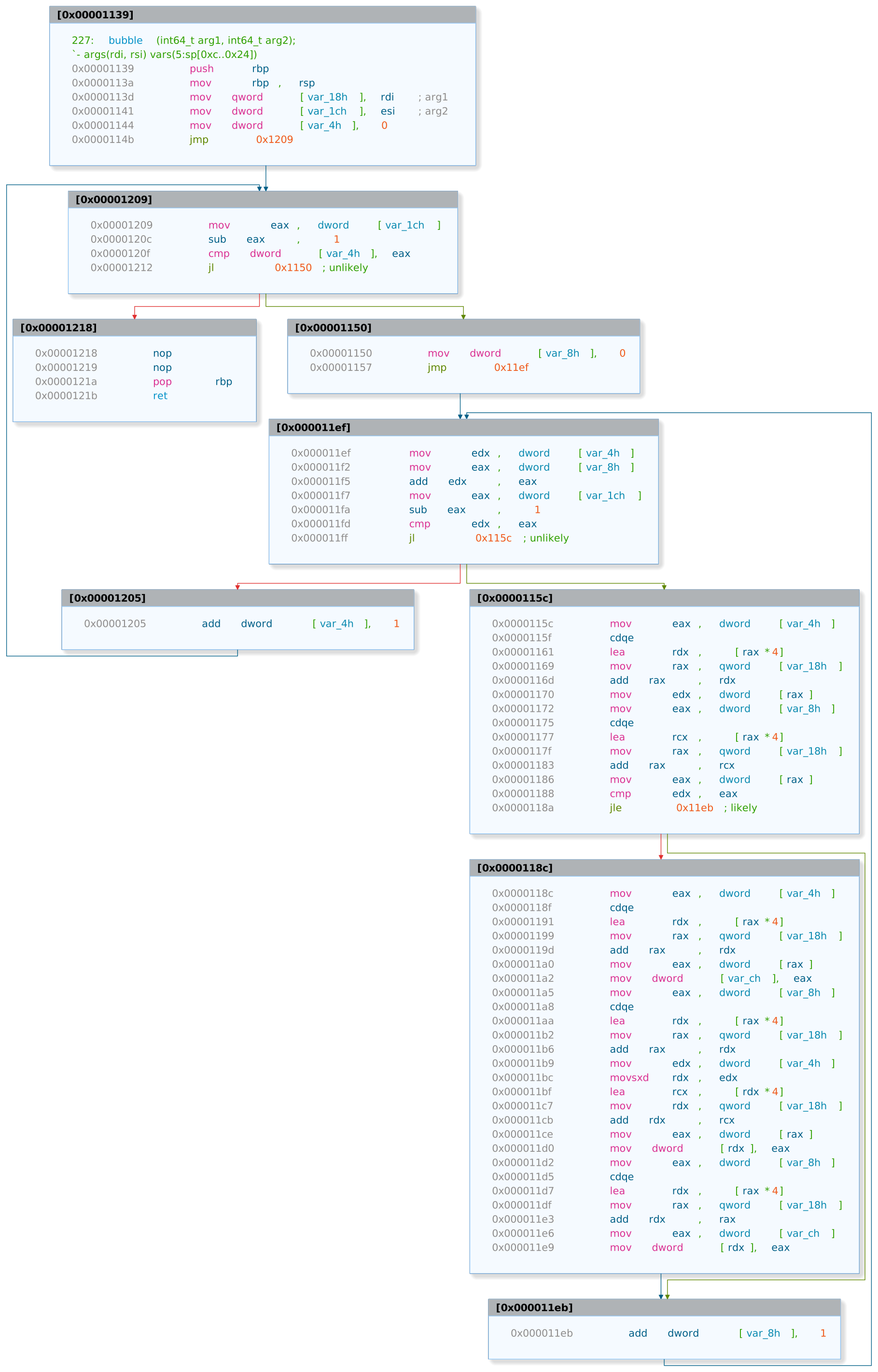
We can see that a counter is set at 0x00001144. Inside the 0x00001209 block, there is a comparison. If the counter has not reached the threshold, execution proceeds. At 0x00001150, another counter is set. Inside the 0x0000115c block, the comparison between two neighbouring numbers takes place. If the first one is larger, a swap is performed inside the 0x0000118c block.
Conclusion
These are just several examples of the patterns we may see during reverse engineering. As we do more and more reverse-engineering work, we will gain more and more experience, and we will be able to identify more patterns in the disassembly quickly.